

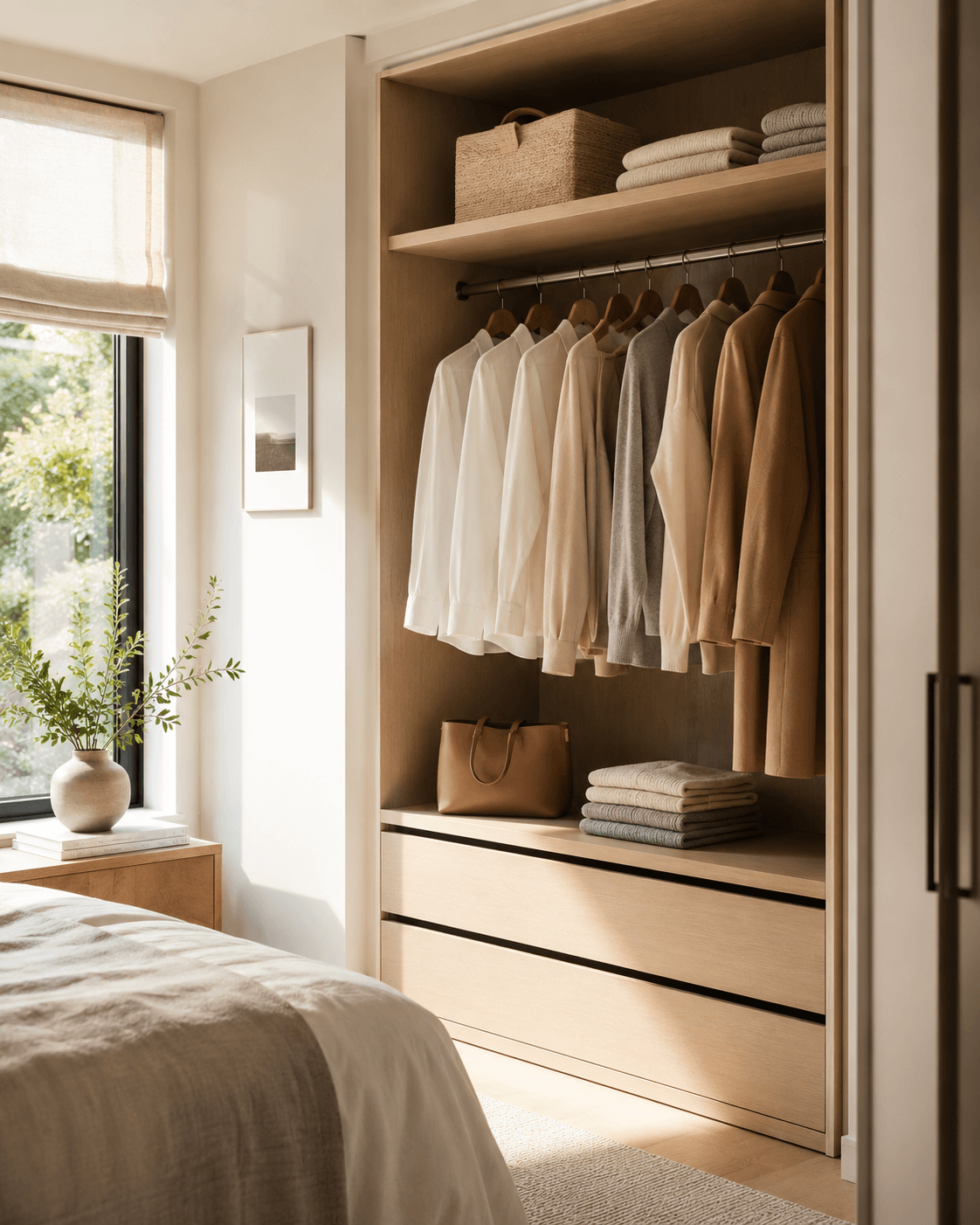
You’re standing in front of your wardrobe. The rail is packed so tight the hangers barely move. There are things folded on the shelf, a pile on the chair, a drawer that won’t quite close. And yet, somehow, you have absolutely nothing to wear.
This is one of the most common and quietly frustrating experiences in modern life. It’s not about having too little — it’s about having too much of the wrong things, in too many mismatched directions, with too few pieces that actually connect. The result is a wardrobe that works against you every morning.
Learning how to build a capsule wardrobe from scratch is the way out of that loop — and this beginner’s guide will show you exactly how to do it. Not because minimalism is a personality trait you need to adopt, and not because you’ll be limited to ten beige items and a sense of smugness. A capsule wardrobe is simply a smaller, more intentional collection of clothes you actually wear — pieces that get on with each other, fit your real life, and make getting dressed feel easy instead of exhausting. This is a beginner’s guide to building one from scratch.
What a Capsule Wardrobe Actually Is (and Isn’t)
A capsule wardrobe isn’t a rigid system with a fixed number of items. It’s not Project 333 (though that’s one approach). The idea of a small, intentional wardrobe has been around since the 1970s, when London boutique owner Susie Faux popularised the concept. It’s not a uniform, and it’s not a punishment.
The core idea is simple: a capsule wardrobe is a collection of pieces you genuinely wear, where most things work together, and where nothing is taking up space just because you might wear it someday or because it was on sale. That’s it. The number doesn’t matter as much as the intention.
The moment I genuinely understood what a capsule wardrobe was for, it changed how I thought about shopping completely. I stopped asking “do I like this?” and started asking “does this work with what I already have?” Those are very different questions. One leads to an impulse buy. The other leads to a wardrobe.
If you’re still figuring out what your style even is, my guide on how to find your personal style is a good place to start before you build your capsule.
Step 1: Before You Build a Capsule Wardrobe, Do a Wardrobe Audit

Before you buy a single thing, you need to know what you’re working with. Pull everything out. Yes, everything. Lay it on your bed or hang it somewhere you can see it all at once.
Then go through each item and sort it into four groups:
- Love and wear regularly. These are your keepers.
- Wear occasionally but like. These stay for now.
- Own but never reach for. Ask yourself honestly: why not? Wrong fit, wrong colour, wrong occasion, wrong feeling?
- Haven’t worn in over a year. Donate, sell, or bin.
The third pile is the most instructive. Those are the clothes that looked good in the shop, or at a price, or in your head — but don’t work in your actual life. Look for patterns. Are they all a colour that doesn’t suit you? All formal pieces you don’t need? All impulse buys from the same type of sale? That pile will teach you more about your future capsule wardrobe than any shopping guide.
When you’re done, only keep what genuinely belongs in your life as it is right now. Not your life three years ago. Not the life you’re planning to have.
Step 2 — Identify Your Core Occasions
Your wardrobe needs to serve your actual life, which means knowing what occasions you’re actually dressing for. Most women’s lives break down into four categories: work, weekend, social, and home.
Work covers whatever you wear to your job — whether that’s a corporate office, a hybrid setup, or working from home with the occasional client meeting. Weekend is errands, casual days out, coffee with friends. Social is anything with a dress code of “smart casual” or above — dates, dinners, events. Home is what you wear to relax in the evenings and on unplanned days.
Roughly estimate the percentage of time you spend in each category. If you work from home full time, you probably don’t need ten blazers. If your social life is very active, you might need more evening pieces than average. Build your capsule to reflect your real ratios, not an imaginary version of your schedule.
The Essential Pieces When Building a Capsule Wardrobe
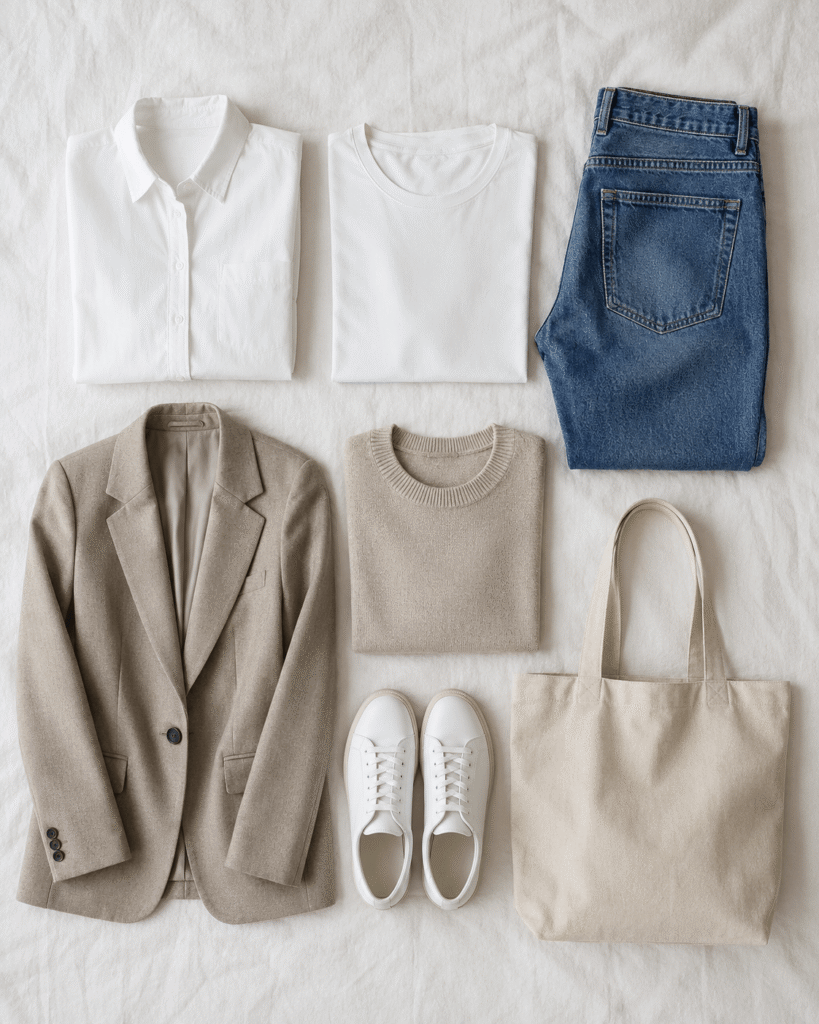
These aren’t rules — they’re starting points. A capsule wardrobe beginner often asks which pieces to prioritise, and the honest answer is that capsule wardrobe essentials for women vary slightly depending on your lifestyle — but most people need the same core categories.
Tops
- 3–4 plain t-shirts or fitted tops in your core neutrals
- 2 shirts (one classic white or cream, one in a neutral or accent colour)
- 1–2 smart blouses or tops for work and evening
- 1–2 knit or jumper-style tops for cooler days
Bottoms
- 2 pairs of well-fitting jeans (one casual, one that works dressed up)
- 1 pair of tailored trousers
- 1–2 skirts or dresses depending on your preference
Layers
- 1 blazer or structured jacket
- 1 casual jacket (denim, linen, or a lightweight bomber)
- 1 warm coat for your climate
- 1 cardigan or knit layer
Shoes and accessories
- 3–4 pairs of shoes covering casual, smart casual, and comfortable everyday — if you’re not sure how to choose, read how to pick shoes that are stylish and comfortable
- A bag that works for day-to-day and can double for evenings
Accessories like jewellery and scarves sit outside the main capsule count for most people but should still follow the same rule: only keep what you actually reach for.
Choosing Your Colour Palette
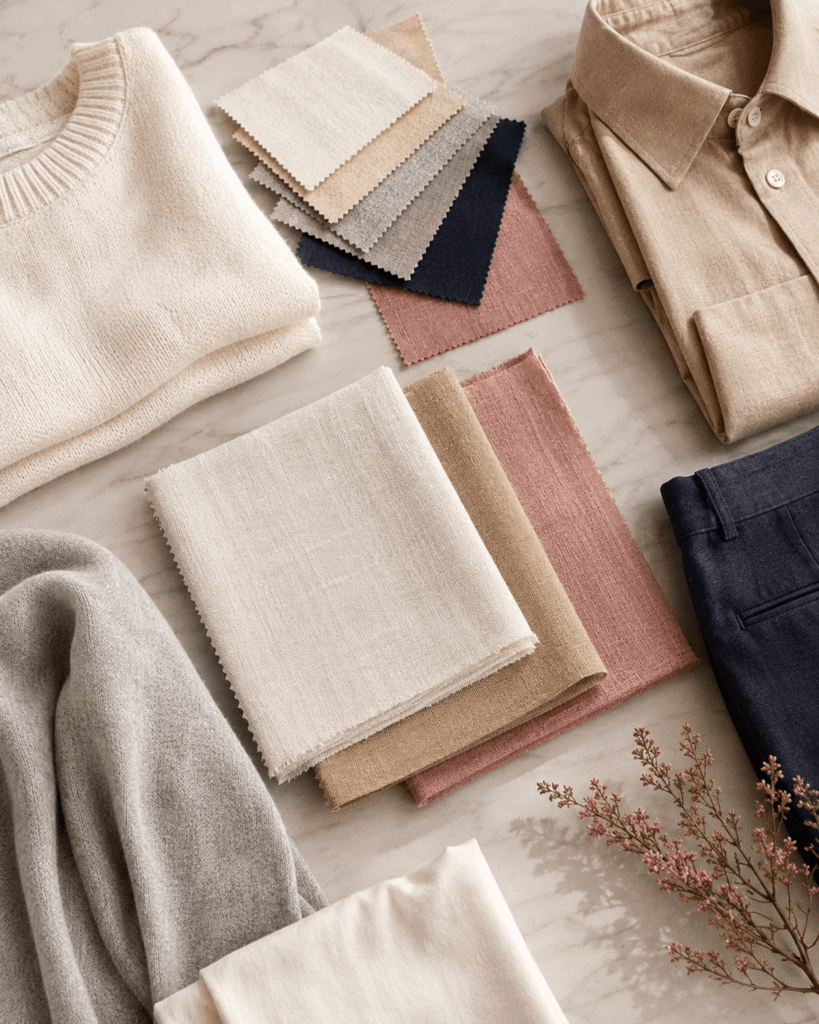
This is where a capsule wardrobe goes from a list of clothes to a wardrobe that actually works together. A minimalist wardrobe for women doesn’t mean colourless — it means cohesive. Without a considered palette, you end up back where you started — lots of pieces that don’t mix.
Start with 3–4 neutral base colours that suit your colouring and that you’re drawn to naturally. Common combinations include black-white-grey-camel, navy-cream-tan-white, or brown-olive-cream-rust. Then choose 1–2 accent colours you love, which can appear in tops, accessories, or one statement piece.
When I first tried to build my capsule wardrobe, I made the classic mistake of picking a colour palette I thought I should want rather than one I actually wore. I went full beige-and-cream because it looked chic on a mood board, then stood in front of my wardrobe feeling washed out every morning. Your palette needs to suit you — your skin tone, your personality, the colours that genuinely make you feel like yourself.
How Many Items Do You Actually Need?
Most women find that 30–40 carefully chosen pieces cover about 90% of their life. That includes clothing only — not shoes, bags, or accessories. In 2025, most style editors agree the number matters far less than the intention behind each piece.
On the lower end (around 30 pieces), you’ll have a very tight, intentional wardrobe with minimal repetition and maximum wearability. On the higher end (up to 40), you have a bit more variety and room for pieces that serve specific occasions. If your life spans a wide range of contexts — formal work, active weekends, regular evenings out — you may comfortably sit at 40–45 pieces.
The number that matters is the percentage you actually wear. If you have 80 items and wear 25 of them regularly, your real wardrobe is already 25 pieces — you just have 55 others cluttering the space and the decision. Trim to what you wear, and you’ve already built your capsule.
How Your Capsule Changes With the Seasons
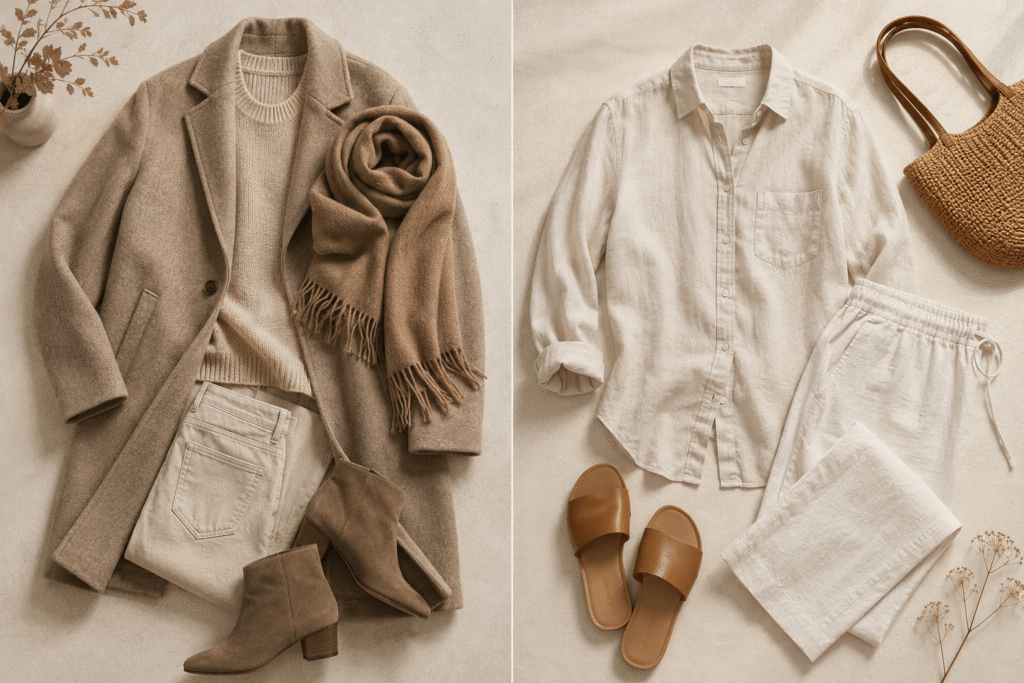
One capsule wardrobe doesn’t have to cover all four seasons at once — but it should be designed with your climate in mind.
If you’re in the UK or Europe, you’re dressing for four genuinely distinct seasons. Your capsule needs proper layering pieces: a warm coat that works for months, not weeks; transitional knits and lightweight jackets for spring and autumn; and a summer base that’s light enough to wear but not so casual it doesn’t work for evenings out. British summers in particular require clothes that work on a 16°C overcast day as well as the occasional warm week.
Women in warmer US climates — California, Florida, Texas — often need fewer heavy layering pieces and more breathable, lightweight fabrics that hold up to heat year-round. Linen, cotton, and light jersey will do more work than wool or heavy knits. The capsule structure stays the same; the fabric weights and layering depth shift.
Some people rotate their capsule seasonally, storing off-season pieces and refreshing a few items each spring and autumn. Others prefer one year-round capsule and adjust with layers. Either approach works — the key is that each season, you’re only dealing with clothes you actually wear.
The Biggest Mistakes People Make Building a Capsule Wardrobe
Buying things on sale that don’t fit your palette. A bargain that doesn’t work with anything you own isn’t a bargain — it’s a future donation. The sale trap is the single fastest way to undo a capsule wardrobe. If it’s not in your colour range or it doesn’t serve a real occasion in your life, it doesn’t matter what it cost.
Building a capsule for an aspirational life, not your actual one. Aspirational dressing is how wardrobes fill up with things that never get worn. The blazers for the office you don’t have, the occasion dresses for the events you haven’t been invited to yet, the exercise kit for the routine you’re planning to start. Build for the life you’re living now.
Making it too restrictive. A capsule wardrobe isn’t a capsule prison. You’re allowed to own a bright print you love even if it doesn’t technically fit the palette. You’re allowed to have a few things that are just fun. The point is intentionality, not austerity. If something makes you genuinely happy when you wear it, it belongs.
Doing it all at once. You don’t need to build the perfect wardrobe in a weekend. Start with the audit. Live in your edited wardrobe for a few weeks and notice what you’re missing. Then fill the gaps deliberately. Gradual and considered will always beat a rushed overhaul.
Building a capsule wardrobe isn’t a project with a finish line — it’s a slightly different way of thinking about what you own and why. Once it clicks, you’ll find the morning panic fades, the impulse buys slow down, and getting dressed stops feeling like a problem to solve.
Start with the audit. See what you actually have. Everything else follows from there.
Once you know your gaps, you might also enjoy reading about how to find your personal style or why the shoes you choose matter more than you think — both sit naturally alongside a capsule wardrobe approach.